
On, our Gomoti driver, got us to the airstrip and our unexpected transport to Machaba Camp, a helicopter. I’d never been up in one. Actually, I have a bit of an issue with them. They don’t glide. But as I always say, feel the fear and do it anyway. There wasn’t actually a spot for a helicopter pad, just a bunch of grass. I asked where the pilot knew to land, and someone said, “Take a left at the warthogs.”
We loaded up and off we went. The very young pilot was from Calgary, Canada, and said it would take him far less time to get his hours in flying in the African bush than back home in Canada. We found that to be the case with our bush plane Cessna pilots as well. He got us safely to Machaba which is a sister camp to Gomoti, north of it and on the Khwai River, still in the Okavango Delta. Turns out I like helicopters!
Machaba is across the river from the Moremi Game Reserve, yet a world away as the entrance to the reserve is about a 40-minute drive from the camp. I asked Rafa, our Machaba driver why the drivers couldn’t just cross the river as their vehicles were all equipped for that? No, I was told, everyone needs to go through the gate and guides must check in. If you cross into the reserve any other way you are considered a poacher, and the Botswana anti-poaching rangers shoot first and ask questions later. Alrighty then!
There is lots to explore outside of the reserve, and we were fortunate to see African Wild Dogs, also known as the African painted dog or the African hunting dog. The dogs are an endangered species in Africa and the second most endangered carnivore in the continent behind the Ethiopian wolf. They are highly social animals, gathering and travelling in packs, but they’re sensitive to habitat changes, which have been significantly reduced over the past few decades. Illegally poaching and wildlife trading is rife across African countries, and many African dogs were caught as bycatch in snares targeted for other animals like antelopes. The dogs are also susceptible to other threats like human conflicts over livestock, infectious diseases like rabies and distemper, and competition with larger predators like lions due to shrinking habitats. The largest populations are mostly in southern Africa – where there are less than 550 individuals in the wild – and the southern part of East Africa including Tanzania and northern Mozambique. We were lucky enough to see 14 of them, and one of the females had just had puppies.
There were more vehicles in this area, and the drivers were alerting each other to sightings. We happened into the area the dogs had been seen, spotted one leaping through the grass and were able to follow it to the rest of the pack where they were chasing down an impala. The dogs are long distance runners and can run 44 MPH; the impalas eventually tire out. But this impala took to the water and the dogs had to swim across. Rafa, our driver, needed to get across the water but it was too deep, so we set out on a hair-raising trip on sand pathways, twisting and turning and bumping up and down at a high rate of speed. Jan looked terrified. I said, “Rafa! You’re crazy! I love it!” as I held on for dear life. He did need to cross the river and Steve Lake yelled, “Feet up!” as the water flooded the floor and came up over the hood. I yelled back, “Feet? My ass is wet!” But we got on to dry land, everything drained and we got to see the dogs up close. From afar we could see the impala try to go into a hippo pool, but the dogs dragged it out. Then the hippos came out of the pool to see who was invading their territory. Lots of noise. We didn’t actually see the kill, as the dogs blocked it from view, and Steve Lake told us they are quite quick and efficient at it. We could see some stains on the grass and dogs tugging between themselves on meat, but everything else was gone! So, if you’re concerned about my pictures and video please don’t be. You won’t see the poor impala lose its life.
We had all this interaction between dogs and hippos, and then a hyena showed up trying to steal anything that remained. The dogs ran him off. It was quite the exciting story by the camp fire that night.
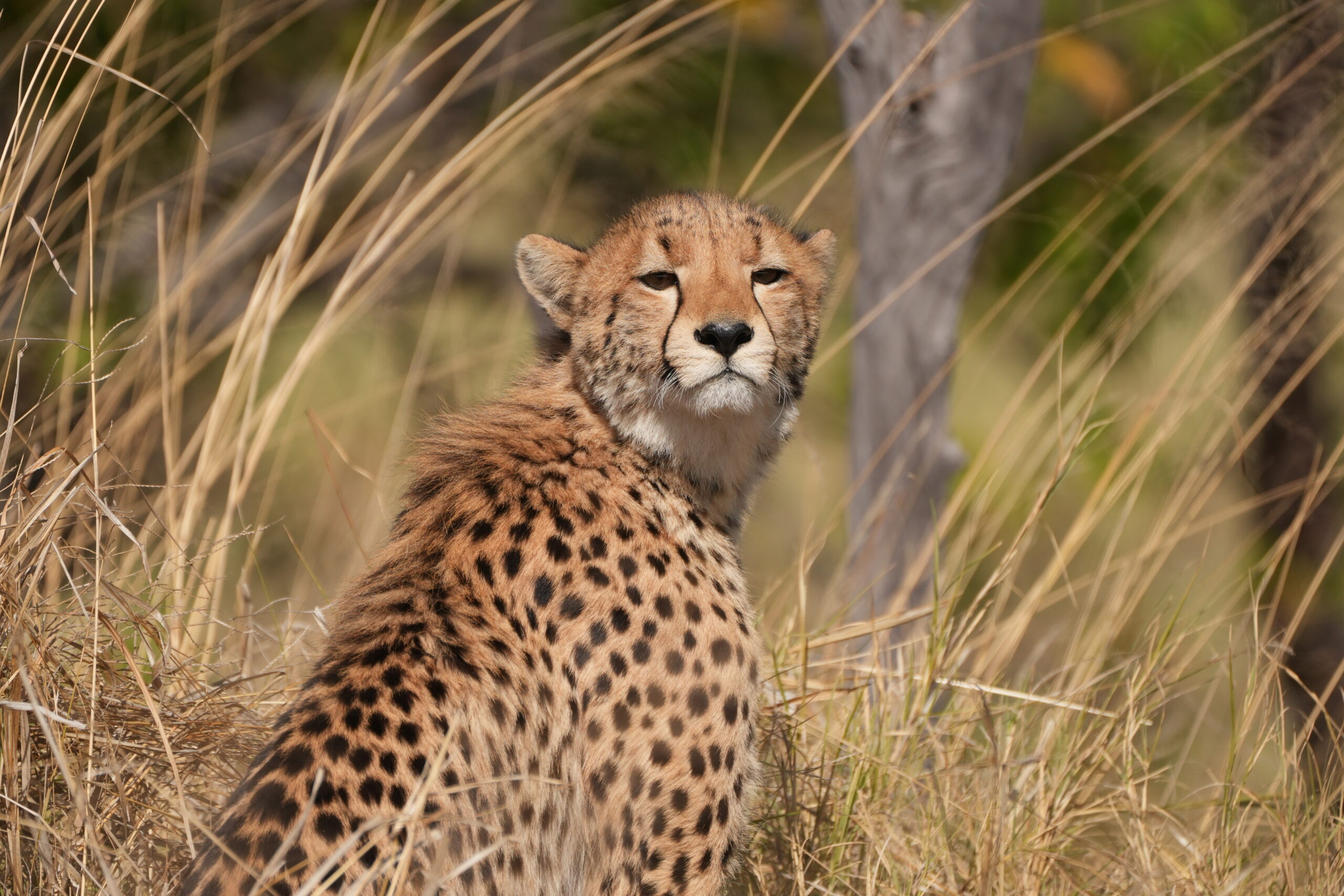
The next day we went to the dog’s den to check on them and they were sleeping in piles in the sun. We saw the female go into the den to feed her pups. The alpha female runs the pack and she wasn’t pushing them to go hunt again, so Rafa and Steve took us to the Moremi Game Reserve on the other side of the Khwai river in search of lions. Well, the lions weren’t cooperating (even though we could hear them from camp) but Rafa found us some cheetahs, and we were the only vehicle there. They were stunning. We got to see a mother and daughter together, lounging, venturing out to look for food, and I swear they were posing for our pictures.
At our late day game drive the dogs were active again, and while they chased an impala but they didn’t catch one this time. All the dogs have a different paint job, all beautiful. How fortunate we were to see them.
We had a bush dinner that night, away from the camp. Such a setting! A long table for all 20 or so guests, a camp fire, bar, and even actual toilets, for which Jan and I will be eternally grateful.
And when we were escorted to our tents we had electric blankets to look forward to.
We were listening to some Baboons having a shouting match that next morning. My Steve looked at me and said, “I wonder how baboons solve their differences. They don’t seem to want to talk it out.”
We were flying to Victoria Falls that day, or hoped we were. There was an elephant on the airstrip…

Next – On to Zimbabwe and the magnificent Victoria Falls
What an adventure. Glad you all made it home safely.
love the pic’s….!!! that closeup of the cheetah…..wow!….. gotta believe your heart rate was a bit elevated on the chopper…..wonderful descriptions…thanks for sharing
Charles/liz