
After our morning with Christo Brand we strolled to the Victoria and Alfred Waterfront, a vibrant and hopping part of the city on the harbor. Steve Lake, our Micato guide showed us the departure dock for Robben Island, where a small museum has been installed inside the ticket office, showing a scale model of Robben Island and the prison. The island is closed to tourists right now and they are working on readying it for when South Africa hosts the G20, so we couldn’t go there. We were supposed to fly over the island in a helicopter that day, which would have been my THIRD helicopter ride in 2 weeks, but the cloud deck was low, so we cancelled. I didn’t want to push my luck.
Robben Island has had multiple uses. In the late 1800’s until 1931 it was a leper colony. Between 1939 and 1945 it became part of the naval defense systems during WWII and was run by the navy until 1959. After the Sharpeville Massacre of 1960 when the apartheid government banned the ANC, PAC and other political organizations the government arrested their leaders and many, including Nelson Mandela were sent to Robben Island.
The museum has letters sent to the Head of Prisons from families to request a visit with those loved ones incarcerated, and the shackles used to lock the legs of prisoners. A prisoner could have one visit of 30 minutes every 6 months. Many prisoners came from outside of Cape Town, some from as far away as Namibia. Most of their families couldn’t afford to travel. Even if they did, the weather could turn foul quickly, and the boats wouldn’t be able to run to Robben Island. To make matters worse during apartheid blacks couldn’t stay in the city; they’d be stranded with no place to go. In 1978 the Western Province Council of Churches opened Crowley House as a place for families to stay when visiting Robben Island. It also provided support when prisoners were released.
I have to say the experience was chilling.
The tenor of the day lightened up from there. We walked past lounging (and squabbling) cape seals.
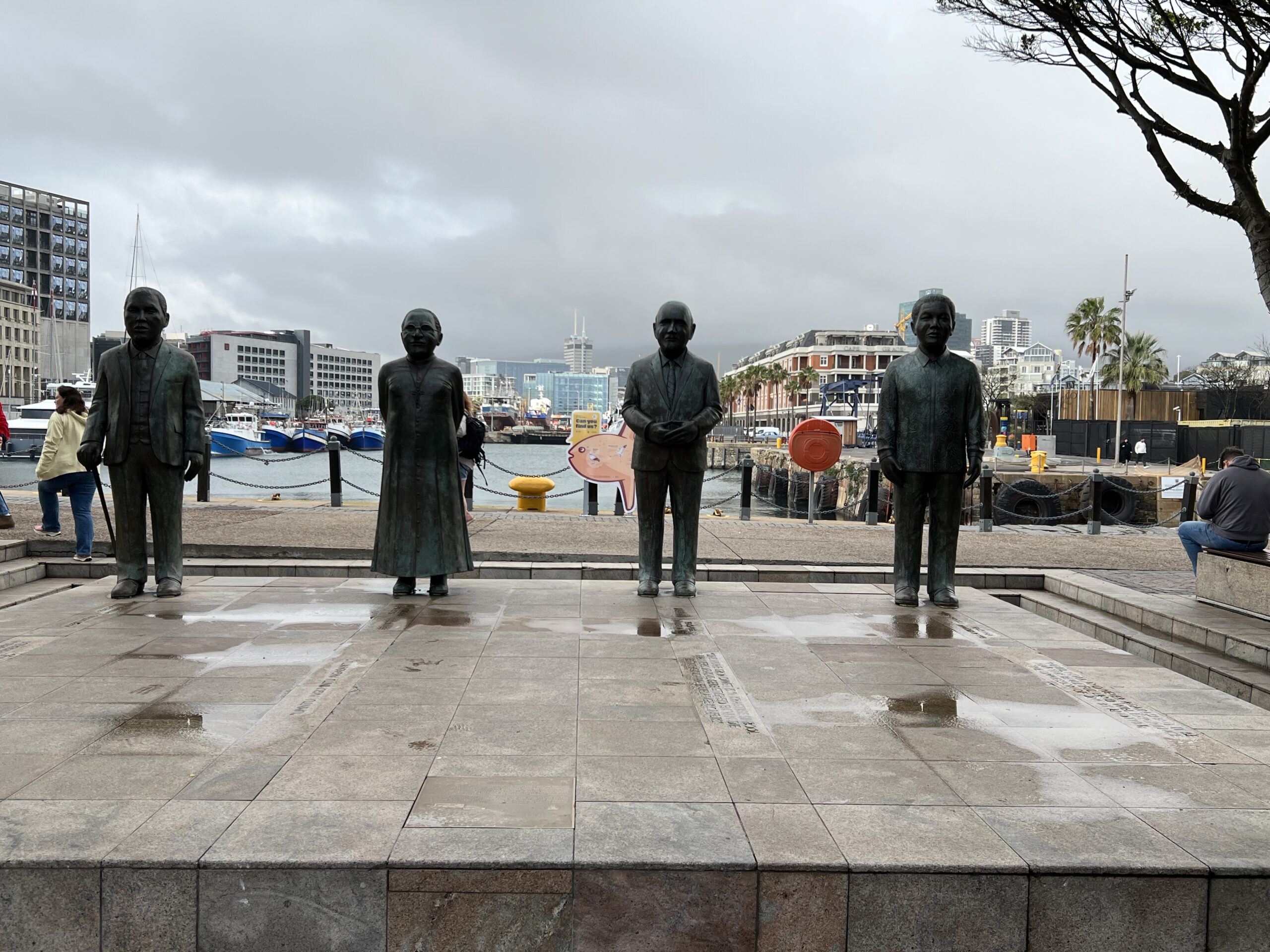
We saw Nobel Square which pays tribute to South Africa’s four Nobel Peace Prize Laureates: Nkosi Albert Luthuli, Archbishop Emeritus Desmond Tutu, former State President FW de Klerk and former President Nelson Mandela. The bronze sculptures of the four Laureates were created by internationally acclaimed artist Claudette Schreuders, and they reflect the ambiguities of the search for an ‘African’ identity in the post-apartheid South Africa. The fifth sculpture in the square, Peace and Democracy, created by Noria Mabasa, acknowledges the contribution of women and children to the attainment of peace in South Africa.
We visited Watershed, a fabulous covered mall of open-air stalls with products made in South Africa. What a breath of fresh air after being subjected to malls with identical stores in every city in America. We brought home some gifts and goodies, reminders of our trip.
And then Steve Lake took us to Seven Colours Eatery, which serves traditional South African food. Seven Colours Eatery is an experience not to be missed. Sunday dinner cooked by the owner Nolukhanyo Dube-Cele (Chef Nolu), a tribal mother, infused with love. She creates beautiful colors and soulful food. She served us steamed buns and roosterkoek – a delicious grilled bread, iGwinya with mince (hamburger meat in a delicious sauce) inside a crispy fried bun, beef potjie, a traditional stew, Umngqusho ongqimbilili (Baked creamy cheesy samp which are dried corn kernels), farm chicken, and everything is always served with chakalaka (chopped vegetables, beans, tomatoes and lots of seasoning), cole slaw and pickled beetroot.
I want to be at this table every day. And I want to be the first one to buy her cookbook.
She also serves wines by a winery called HER, whose management team is comprised of a group of black women who, by grabbing at opportunity, working hard and relying on each other, have stepped into the world of business, previously unattainable to their families, particularly the women. That is why they have pledged to contribute 2% of their profits to a scholarship fund to enable young, talented and driven individuals to achieve their dreams. Those eligible to apply are from families currently working on the wine farms that supply grapes for the HER Wine Collection. The successful candidates are given financial assistance to educate themselves, as well as mentorship to help them negotiate the rigors of the business world. And I was excited to learn these wines are available in the US.
And when we returned to The One and Only, Yaseen, our Micato concierge had arranged for another massage. I could get used to this.

Leave A Comment