
Day 7 – Kinderdijk
Today we are in Holland. We start our excursion in Gorinchem, a charming town where our bus will take us to our destination, the Booij Dutch cheesemakers.
I wish we’d had more time to explore here. Gorinchem is recognized as part of the Holland Waterlines extension to the original Defense Line of Amsterdam. It is the largest completely intact star-shaped fortified city in the Netherlands, featuring preserved 16th- to 17th-century earthwork ramparts, bastions, and a green ring of trees.
In 2021, Gorinchem was also voted the most beautiful fortified town in the Netherlands. With the flowers blooming and the beautiful architecture I could see why. There was an interesting set of statues on the waterfront; the Dol Hareubang statues, which are a unique pair of traditional South Korean stone monuments.
Why are they in Gorinchem? The statues were gifted to Gorinchem by Seogwipo City on Jeju Island, South Korea, to honor deep historical ties dating back over 460 years. Gorinchem is the hometown of Hendrick Hamel (1630–1692), a Dutch East India Company sailor. In 1653, Hamel shipwrecked on Jeju Island and lived in Korea for 13 years. Upon returning back to Europe, he wrote The Journal of Hendrick Hamel, which became the very first book to introduce Korea to the Western world. Literally translating to “stone grandfathers” in the Jeju dialect, these statues are iconic symbols carved from porous volcanic basalt rock. It’s interesting how their hands rest symmetrically on their bellies (with one hand slightly higher than the other). I loved that they were smiling! In Korean folklore, they serve as powerful village guardians meant to ward off evil spirits, offer protection, and promote fertility. It was such a surprise to see them in Holland.
We arrived at Booij Cheesemakers to be greeted by a very friendly cat. I’d hang out there if I was a cat.
At Booij we got to see a bit of the cheesemaking process, the aging rooms, the cows and sheep, even though they source their milk from other farms. The ingredients are simple; milk, a starter culture, rennet, and salt. What makes Gouda taste different from other chesses? They wash the curds. After the milk curdles and some whey is drained away, warm water is added to rinse the cheese curds. This washes away part of the lactose. With less lactose left to convert into lactic acid during aging, Gouda lacks the sharp, tangy bite of cheeses like cheddar. Instead, it has a naturally sweet, mild, and buttery character. And it also depends on the milk. Sheep’s milk gives a very different flavor. And aging Gouda makes it saltier, nuttier and sharper. We felt bad for the guide at Booij; it was her first day and she was having some issues with the language. She was very sweet, and tried her best to answer everyone’s questions, and our Viking guide helped her out. And we all bought cheese to take home. Aged Gouda and Truffle Gouda for us, and a bag of cheese rusks a bakery makes for them. When we got home I made a lovely vegetable soup that I planned to serve us with the cheese rusks, but when I went to look for them Steve had eaten them all.
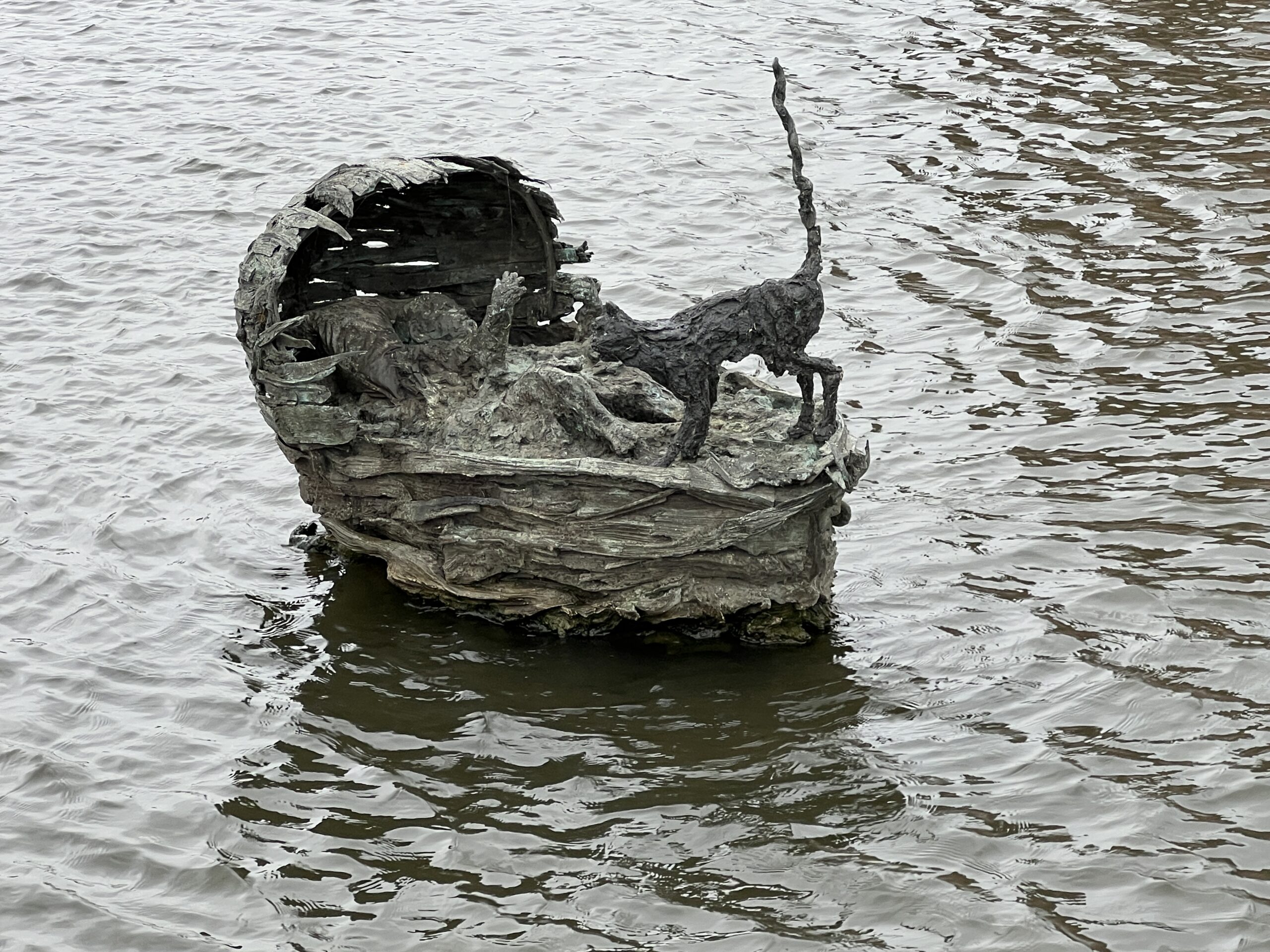
We then ventured on to Kinderdijk, which means “children’s dike,” and it refers to a legend about the devastating St. Elizabeth’s Flood of 1421. After the storm, a local boy went to inspect the damage at a dike that separated the Alblasserwaard and Grote Hollandse Waard. He was astonished to see a cat jumping back and forth on a rocking wooden cradle to keep it from tipping over into the water. Inside was a sleeping a baby girl, safe and dry. The village and dike where this miracle supposedly took place were named Kinderdijk in honor of the child. A bronze sculpture commemorating the story – known as The Cat and the Cradle – is visible in the water at the visitors’ center near the windmills. And, of course we all know the story of the Little Dutch Boy. Not true, but a good story, nonetheless.
A thousand years ago, the area was a peat bog. As people dug up peat and drained the soil, the land began to compact and sink well below sea level. To stop catastrophic flooding from high water levels, two distinct rows of drainage windmills were constructed in the mid-18th century. Designated a National Monument in 1993 and inscribed as a UNESCO World Heritage Site in 1997, Kinderdijk remains fully functional today as a standby backup system operated in coordination with modern water stations. Many mills are still inhabited by traditional miller families. And based on what we saw on the tour it takes a lot of gumption to be a miller. The preserved windmill, with its garden, geese, outhouse, kitchen shack and very, very tiny beds did not look like high living. But as an historical site it was all quite beautiful.
Next up – Amsterdam!

Leave A Comment