Day 3 – Kehl, Germany/Strasbourg, France
The cultural center of France’s Alsace region, Strasbourg is an Island with a personality disorder. It’s not sure if it’s French or German. Our guide was German, and she very much tried to get us to lean German. Kehl, Germany is right across the river and where our ship was docked. A short bus ride to “Petit France” which is enclosed on all sides by the Ill River and you are in the middle of wooden houses, cobblestone streets and beautiful canals. Even though the weather had turned to fall-ish temperatures the flowers were in bloom and the sun was shining. A great day to explore.
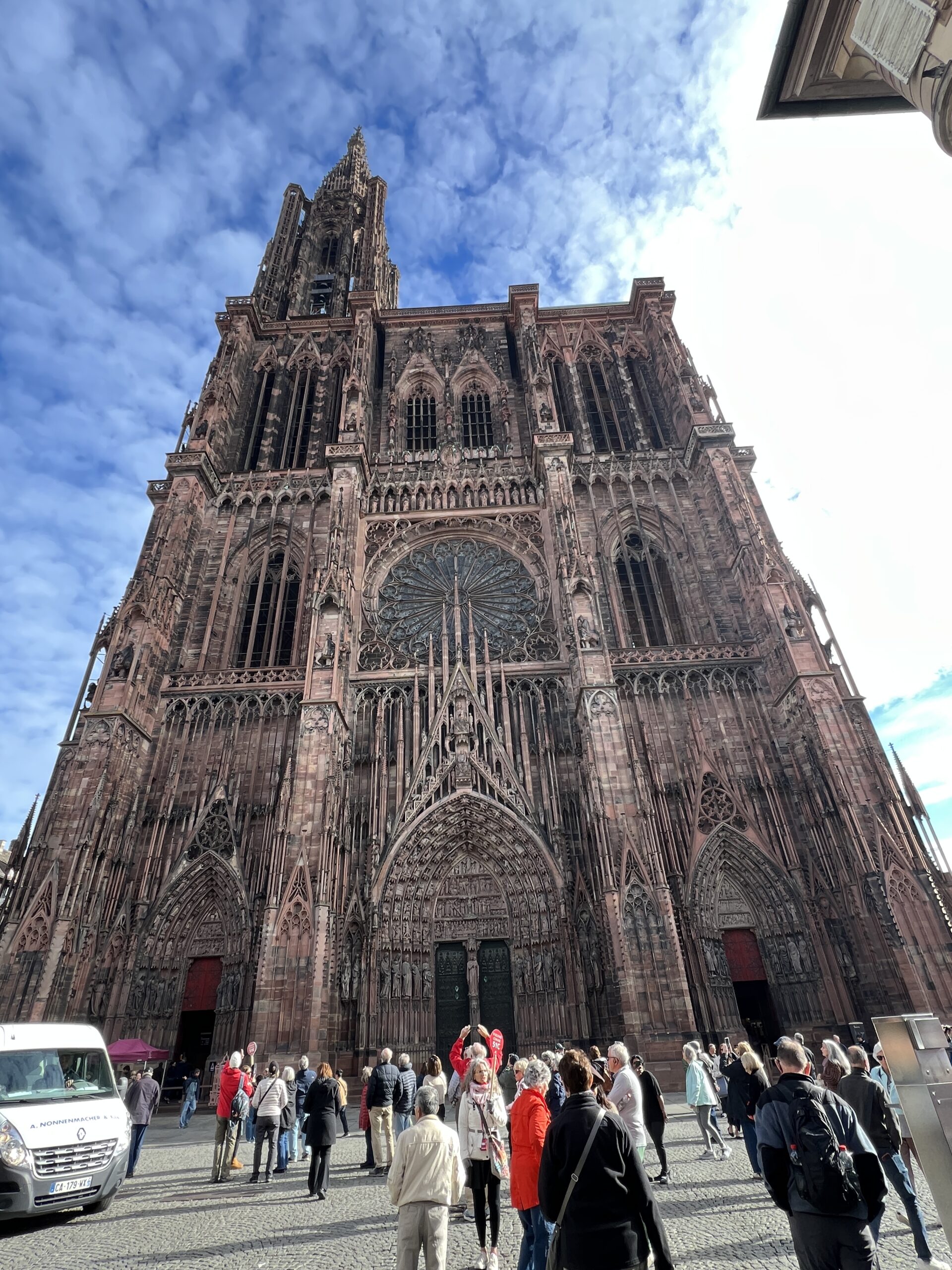
Strasbourg’s historic city center, the Grande Île (Grand Island), was the first full city center to be classified as a UNESCO World Heritage Site in 1988. The Gothic Cathédrale Notre-Dame has a pink sandstone façade and a 465-foot spire that made it the world’s tallest building for over 200 years (from 1439 to 1874). BUT it only has one tower. I think the jury is still out on whether the construction would have been too heavy, or they just plain ran out of money. The interior of the cathedral houses an intricate 19th-century astronomical clock that is completely mechanical. We were able to be there on the half hour to see the clock in action.
Strasbourg hosts the Christkindelsmärik, widely considered the oldest Christmas market in Europe, which has operated since 1570. Our guide said we should add Christmas in Strasbourg to our bucket lists. They’ve already started putting up decorations.
Strasbourg is home to the European Parliament; it is also home to the Council of Europe and the European Court of Human Rights.
Fun facts! The French national anthem, La Marseillaise, was composed in Strasbourg by Rouget de Lisle in 1792. And they have a carousel! And of course Charles had to ride it!
Steve and I took part in an Alsace wine tasting in the afternoon. Our Guide, Robin, is French, and HE tried to sway us back to leaning French. I do think they’re still fighting a war as the area alternated between French and German rule throughout a history spanning over two millennia.
Robin was not only a guide but a wine enthusiast of high order. He studies terroir, especially the rocks in the ground beneath the vineyards that give so much flavor to the wines. On the bus to the vineyard we visited, Domaine Hering in the town of Barr, we talked about the variety of grapes grown there; Reisling, Pinot Gris, Pinot Blanc, Gewürztraminer, Pinot Noir – the only red, and Muscat. Interestingly they do grow Chardonnay grapes, but can only use them in Cremant, a sparkling wine in the Méthode Champenoise that they cannot call Champagne because it is not made in the Champagne region, and because it is not considered one of the noble vines in Alsace.
The vineyard has been in the same family since 1858. The current vintner’s grandfather planted pinot noir years ago to the horror of the Alsace winemakers’ association. He sensed the warming climate was going to affect their ability to grow certain varieties, and sure enough, about ten years ago the local association approved Pinot Noir for bottling as an Alsace appellation wine, and even a Grand Cru.
The vines are planted on a hillside where water run off the hill quite fast. They don’t irrigate; they want the vines to work for it, some growing as deep as 75 feet. The limestone gives the wine is distinct flavor. I asked if they netted the vines but they said no; birds aren’t the problem, wild boar and deer are! They said the deer are stupid and just eat the leaves. In the fall when they are ripening the sweet grapes they install electric fencing to keep the critters away. Usually, the vineyard harvests in September and October, this year they were finished in September. Climate change is affecting everything.
We tasted four wines, a Reisling, Rosengert which is a blend, Gewürztraminer, and Pinot Noir. Their Reisling was outstanding. I wish they exported to the US, but unfortunately they do not. They did a clever thing on their back labels; a dry to sweet scale! A buyer can judge how dry (or sweet) the wine is before purchase. They also put the number of years to cellar the wine before drinking. No wine has ever lasted that long in our house so that part would be wasted on us.
They also put the number of years to cellar the wine before drinking. No wine has ever lasted that long in our house so that part would be wasted on us.
I did buy two bottles of Cremant to take back to the ship, and we did a tasting with our group. Well, more like a drinking with our group. And at dinner our waiter brought a full rack of Kolsch beer by and our beer enthusiasts, John and Claudia, told him to leave it. He did. Oh, my.
Next up – Ship Swap and Luxembourg!

Leave A Comment