
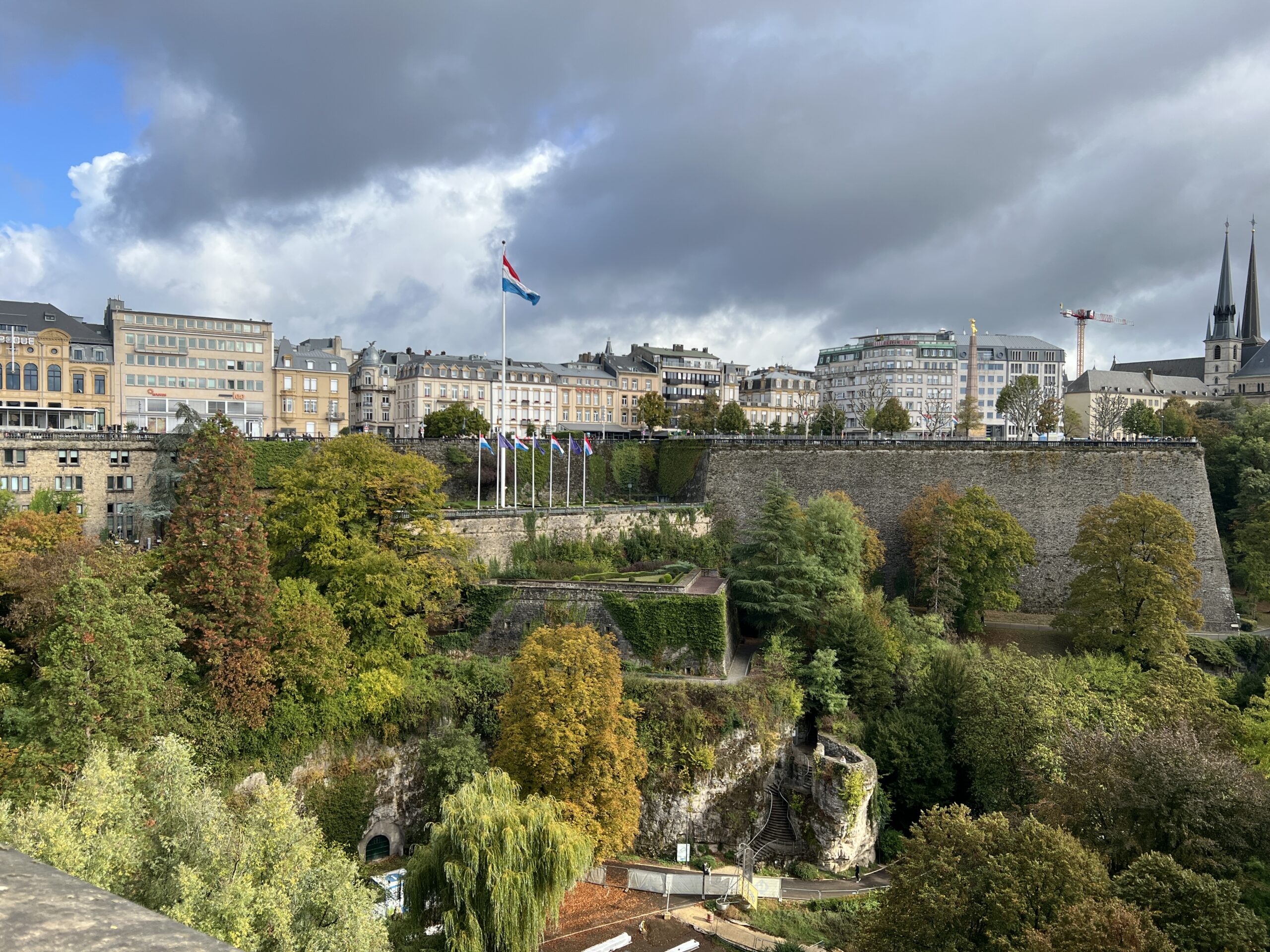
Day 4 – Luxembourg
Ship swap day! We packed our bags and left them outside our staterooms before breakfast and said goodbye to our waiters and bartenders on the Einar as we were transferring to the Sigrun in the late afternoon. We then headed to motor coaches for our very pastoral bus ride to Luxembourg. We had a few hours to explore and have lunch on this brisk October day.
Luxembourg is a landlocked country bordered by Belgium, Germany and France.
It has its own national language, Luxembourgish, but also has two other official languages, French and German, and 80% of the population also speak English. I can’t imagine having to learn 3-4 languages. I have enough trouble with one.
Luxembourg is a parliamentary representative democratic monarchy and the world’s only sovereign grand duchy. It has an area of 1000 square miles, so it’s smaller than Rhode Island, and has 700,000 residents. While we were there, we were able to take in the Grand Ducal Palace and had lunch at the Bistrot de la Presse right across the street. Based on the pictures and articles on the walls this is where the Press hang out. And there we encountered one of the 20% of the population that doesn’t speak English. Thankfully one of the staff that DID speak English came to her rescue. We had local specialties like Goulach and Judd mat Gaardebounen (smoked pork collar with broad beans), and Bouneschlupp (green bean and bacon soup). All were delicious. And of course, local beer and Cremant.
Our sightseeing included the monument to the Grand Duchess Charlotte, the Kaddish monument and Notre Dame cathedral.
The Kaddish monument is in memory of the Victims of the Shoah in Luxembourg (1940-1945). It’s named after the Kaddish, one of the most famous Jewish prayers recited as part of mourning rituals in Judaism. Below is a very moving interpretation of the monument as suggested by the artist.
Facing the monument, the onlooker discovers two upturned heads at the bottom, whose hair turns into devouring flames, flames of memory which, as they rise, surround a large hollow narrowing before transforming into a channel of light. The upturned heads symbolize death. The flames on the right rise towards the man who is covering his eyes with his hand in order to recite the Shema, the prayer said by Jews in the face of death, a gesture symbolical for the world turning away its gaze so as not to witness the enormous crime being perpetrated. To the left, a flame rises towards the shape of a head with a large eye, the eye of the world that sees everything. The hand below symbolizes the indifference and inaction of the world. From the flames moving to the left emerges a hand holding a child and the Hebrew letter “lamed” which winds from the bottom to the top. At the back of the sculpture, at the bottom, the onlooker discovers the head of a martyred man. His beard transforms into flames that rise towards a woman’s upturned head, turning into a vortex of fire. To the left of the channel of light, which rises in the center, appears the Hebrew letter “vav”. Under the “vav” looms the head of a woman with a swaying body and another tilted head, as well as a hand holding a baby, trying to save it as flames erupt from all sides. In Hebrew, the two letters “lamed” and “vav” which emerge from the flames have the numerical value 30 for the “lamed” and 6 for the “vav”, thus equaling a total of 36. According to cabalistic tradition, the constant existence on Earth of 36 hidden righteous people is a guarantee for the survival of our world.
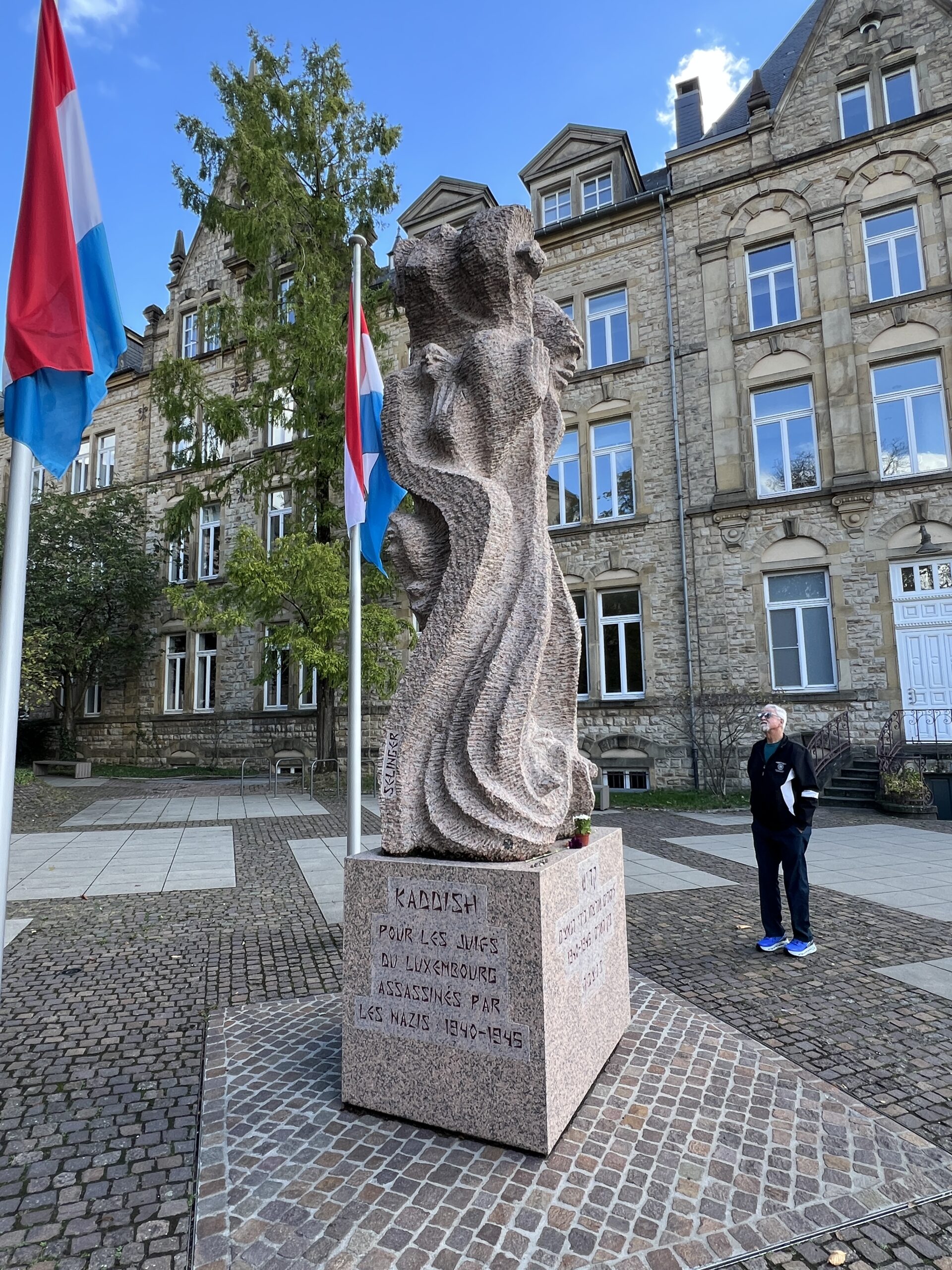
I got chills.
Notre Dame cathedral has been in constant reconstruction since its tower was destroyed by fire in 1985. The cathedral was built between 1613 and 1621 by the Jesuits to serve as a church to their college (now the National Library). The crypt is the resting place of John the Blind, King of Bohemia and Count of Luxembourg, as well as deceased members of the Grand Ducal family.
The Lion Fountain was quite interesting. Five gargoyles, which served to drain rainwater from the roofs of the former seminary, were incorporated into a new wall fountain. The faces have frightening expressions and serve a symbolic function of warding off evil spirits and protecting sacred places. The oval-shaped basin, made of black granite, is decorated with a mosaic. I think I might like to have a gargoyle fountain. The squirrels would love it.
We met up with our Program Director, Sam, to head back to the busses for our drive to our new ship, the Sigrun, in Brussels. But not before Charles got to play line leader with the paddle…
Next up – Brussels, Belgium

I had read about John the Blind, who died at the Battle of Crecy after insisting he take part in the (unsuccessful) defense against the English. Talk about dying with one’s boots on. Thank you for another interesting installment!
For those who don’t know this interesting tale the medieval French chronicler Jean Froissart left the following account of John the Blind’s last actions:
…for all that he was nigh blind, when he understood the order of the battle, he said to them about him: ‘Where is the lord Charles my son?’ His men said: ‘Sir, we cannot tell; we think he be fighting.’ Then he said: ‘Sirs, ye are my men, my companions and friends in this journey: I require you bring me so far forward, that I may strike one stroke with my sword.’ They said they would do his commandment, and to the intent that they should not lose him in the press, they tied all their reins of their bridles each to other and set the king before to accomplish his desire, and so they went on their enemies. The lord Charles of Bohemia his son, who wrote himself king of Almaine and bare the arms, he came in good order to the battle; but when he saw that the matter went awry on their party, he departed, I cannot tell you which way. The king his father was so far forward that he strake a stroke with his sword, yea and more than four, and fought valiantly and so did his company; and they adventured themselves so forward, that they were there all slain, and the next day they were found in the place about the king, and all their horses tied each to other.
D.